
Computer Support Specialist Certificate in Connecticut: 12 Weeks
Earn a Computer Support Specialist Certificate, 12 weeks to less than 1 year In-person at Connecticut State Community College and start an IT career fast.

By Stacy Harper
Landing an entry-level IT job in Connecticut often starts with proving you have practical, hands-on skills. Employers from Hartford to New Haven need technicians who can troubleshoot hardware, configure networks, and support the software that keeps businesses running. The Computer Support Specialist Certificate, 12 weeks to less than 1 year In-person at Connecticut State Community College, gives you a direct path to those skills without committing to a two-year or four-year degree. You get face-to-face instruction, access to campus labs, and a credential that speaks to employers who need reliable help desk and desktop support staff.
Connecticut State Community College (CT State) operates a network of campuses across the state, and its short-term certificate programs are built for adults who want to enter the workforce quickly. The computer support specialist pathway is designed for people who are new to IT, changing careers, or upgrading skills they already have. Because the program is in person, you learn in a structured environment with instructors who can answer questions in real time and classmates who become part of your professional network.
This article explains what the certificate covers, how long it takes, what it costs, where the campuses are, and how to decide if this fast-track credential fits your goals. It also covers job outcomes, salary expectations, and how to use the certificate as a stepping stone to further education if you decide you want a degree later.
What the Computer Support Specialist Certificate Covers
Short-term IT certificates focus on the skills that help desk and desktop support technicians use every day. At CT State, the computer support specialist curriculum typically includes a mix of hardware, software, networking, and customer service topics. You learn how computers work inside and out, how operating systems are installed and configured, how devices connect to networks, and how to diagnose problems when something fails.
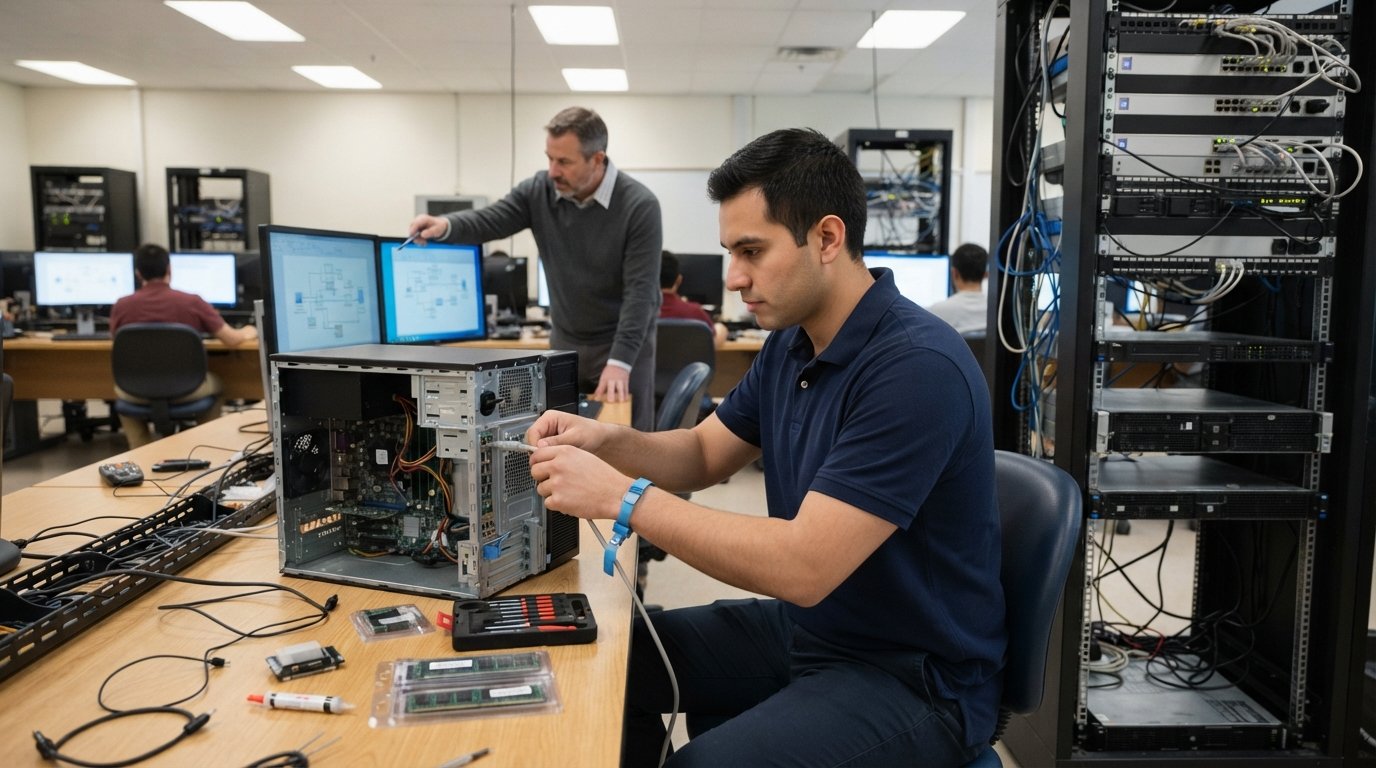
Coursework usually includes hands-on labs where you disassemble and reassemble computers, install operating systems, set up user accounts, and practice troubleshooting scenarios. Many programs also introduce security fundamentals, such as password policies, malware removal, and safe browsing practices. Because support specialists interact with users constantly, communication skills are woven into the training: you learn how to ask clarifying questions, explain technical concepts in plain language, and document issues so other technicians can follow up.
Typical topics you can expect to study include:
- Computer hardware components, assembly, and repair
- Operating system installation, configuration, and troubleshooting (Windows and often Linux)
- Networking basics: IP addressing, routers, switches, and wireless connectivity
- Security essentials: malware, firewalls, authentication, and data protection
- Help desk procedures, ticketing systems, and customer service techniques
Many CT State campuses align the certificate with industry certifications such as CompTIA A+, Network+, or Security+. Even if the certificate itself is your goal, preparing for these exams adds value to your resume. Employers often list A+ as a preferred or required credential for entry-level support roles, so the combination of a college certificate and an industry certification can make you a stronger candidate.
The program is also stackable. Credits you earn in the certificate may apply toward an associate degree in computer information systems, networking, or a related field if you choose to continue your education. That flexibility means you can start working sooner and still keep the door open to advancement.
Program Length and Format: 12 Weeks to Less Than 1 Year
One of the biggest advantages of this certificate is its compressed timeline. Depending on the campus and course schedule, you can complete the program in as little as 12 weeks or spread it across two or three semesters, finishing in less than a year. Full-time students who attend day classes and take multiple courses per term often finish fastest. Working adults may prefer evening or part-time schedules that stretch the program closer to a year but still allow them to keep a job while they study.
Because the format is in person, you attend classes on campus rather than completing coursework online. That matters for hands-on training: you get access to physical labs, networking equipment, and instructors who can watch you work through a problem and correct your technique on the spot. In-person learning also creates accountability. You show up at a scheduled time, work alongside classmates, and build relationships that can lead to job referrals later.
CT State campuses are located throughout Connecticut, including in cities such as Hartford, New Haven, Bridgeport, Waterbury, Norwich, and Manchester. Not every campus offers every course in every term, so you should check with the specific campus you plan to attend for the current schedule. Some students combine courses from more than one campus if a required class is not available nearby, though it is usually simpler to pick one location and follow its sequence.
If you are comparing in-person and online options, it helps to think about how you learn best. In-person programs are ideal if you want structure, immediate feedback, and hands-on practice. Online programs can be more flexible for people with unpredictable schedules. If you are exploring other short-term credentials as a comparison, you can read about a pharmacy certificate with in-person and online options to see how another 12-week program structures its format.
Admission Requirements and How to Enroll
Community college certificate programs are generally open to students who have a high school diploma or equivalent, though some campuses allow students to enroll before finishing high school through dual enrollment or early admission. CT State uses a straightforward admissions process: you apply to the college, submit transcripts or proof of completion, and take placement tests if needed to determine whether you need developmental coursework in math or English.
For the computer support specialist certificate specifically, you usually do not need prior IT experience. The program starts with foundational concepts and builds from there. That makes it accessible to career changers who are coming from retail, customer service, healthcare, or other fields where they developed people skills but not technical skills. If you already have some IT knowledge, you may be able to waive certain introductory courses or move more quickly into advanced topics.
Steps to enroll typically look like this:
- Complete the CT State application online and choose a campus.
- Submit official high school transcripts or equivalent documentation.
- Take placement tests or submit SAT/ACT scores if required.
- Meet with an academic advisor to map out your certificate courses.
- Register for classes and pay tuition or set up a payment plan.
Financial aid may be available for certificate programs that are eligible, and Connecticut residents should ask about state grant programs and workforce development funding. Some employers also offer tuition reimbursement for short-term credentials that directly relate to your job. Even if you do not qualify for federal aid, community college tuition is typically far lower than private bootcamps or four-year institutions.
It is also worth asking about credit for prior learning. If you have already earned CompTIA certifications or completed relevant coursework elsewhere, you may be able to receive credit toward the certificate, shortening your time to completion. Advisors can review your transcripts and certifications to determine what transfers.
Cost, Financial Aid, and Return on Investment
Cost is one of the main reasons students choose community college certificates over private training programs. CT State charges per credit, and the computer support specialist certificate usually requires a manageable number of credits, often in the range of 18 to 30 depending on the campus and whether you need preparatory courses. That means total tuition can be a fraction of what you would pay at a for-profit bootcamp.
Beyond tuition, budget for textbooks, lab fees, and certification exam vouchers. Some courses include exam preparation, but the exam fees themselves are often separate. If you plan to take CompTIA A+, for example, you should factor in the cost of the voucher, which is a few hundred dollars. Many students take the exam while enrolled so they can list the certification on their resume before they graduate.
Financial aid options include federal grants, state aid, scholarships, and payment plans. Connecticut has workforce development programs that sometimes cover short-term training in high-demand fields like IT. Veterans may qualify for benefits that apply to certificate programs. Because the certificate is short, even paying out of pocket is often feasible for students who work part time while enrolled.
The return on investment depends on how quickly you find a job and what you earn. Entry-level help desk and desktop support roles in Connecticut often start in the range of $40,000 to $55,000 per year, with higher pay in the Hartford and Stamford areas. As you gain experience and add certifications, you can move into network administration, cybersecurity, or systems administration roles that pay significantly more. Compared with the cost of the certificate, the payback period can be short if you land a full-time position soon after finishing.
If you want to compare programs and request information from schools that match your goals, you can use a college matching service to explore options without any obligation to apply. That can help you see how CT State's certificate compares with other short-term IT programs in the region.
Career Outcomes and Job Outlook for Support Specialists
Computer support specialists are in steady demand because nearly every organization relies on technology. Hospitals, schools, banks, manufacturers, and small businesses all need people who can keep computers and networks running. The U.S. Bureau of Labor Statistics projects modest but stable growth for computer support occupations, with thousands of openings each year as workers retire or move into other roles.
In Connecticut, the job market includes state government, insurance companies, healthcare systems, and a growing number of technology startups. Help desk roles are often the entry point, and from there you can specialize. Common job titles for certificate holders include:
- Help Desk Technician
- Desktop Support Specialist
- IT Support Analyst
- Computer Technician
- Customer Support Engineer
Many of these roles offer predictable schedules, though some help desk positions require evening or weekend coverage. Remote work is common in support roles, especially for phone and chat-based help desks, which can expand your job options beyond your immediate area. Employers often value certifications and hands-on experience more than a specific degree for entry-level support, which is why a short-term certificate plus CompTIA A+ can be enough to get hired.
Advancement typically comes from adding skills. After a year or two in a support role, you might pursue network administration, cybersecurity analysis, or cloud support. Some students return to CT State to complete an associate degree, which can qualify them for higher-level positions or transfer to a four-year program. The certificate is not a dead end; it is a launch point.
Is This Certificate Right for You?
The Computer Support Specialist Certificate, 12 weeks to less than 1 year In-person at Connecticut State Community College, is a strong fit for people who want to enter IT quickly, prefer hands-on learning, and live near a CT State campus. It is less ideal for someone who needs a fully online program or who wants to skip directly into software development or cybersecurity without first learning the fundamentals.
If you are unsure, consider visiting a campus, talking to an advisor, and sitting in on a class. Ask about job placement rates, internship opportunities, and which certifications graduates typically earn. Those details will help you judge whether the program delivers the outcomes you need.
For adults juggling work and family, the compressed timeline is a major advantage. You can finish in a single semester in some cases, which means you are not putting your life on hold for years. And because the training is practical, you can start applying for jobs while you are still enrolled, using your coursework and lab projects as evidence of your skills.
Taking the first step can be as simple as requesting information from CT State or using a matching platform to compare programs side by side. The sooner you start, the sooner you can move into a role that offers stability, growth, and the satisfaction of solving real problems for real people.