
Construction Trades Associate's at Atlantic Cape: 2-Year Path
Explore the Construction Trades, General Associate's degree, usually 2 years In-person at Atlantic Cape Community College. Call (877)-218-7081 for guidance.

By Stacy Harper
Finding a hands-on career that does not require four years of college is easier than many people think. The Construction Trades, General Associate's degree, usually 2 years In-person at Atlantic Cape Community College gives students a direct route into an industry that always needs skilled workers. This program blends classroom instruction with real shop time, so graduates leave with the confidence and technical ability that employers actually look for. If you are exploring options in the trades, this degree deserves a close look.
What the Construction Trades, General Associate's Degree Covers
This program is designed as a broad introduction to the building trades rather than a narrow focus on one craft. Students learn framing, electrical basics, plumbing, HVAC fundamentals, and construction safety. The general track means you get exposure to multiple areas before deciding where to specialize. That flexibility is valuable because many people enter the trades without knowing whether they prefer residential work, commercial projects, or something like welding or carpentry.
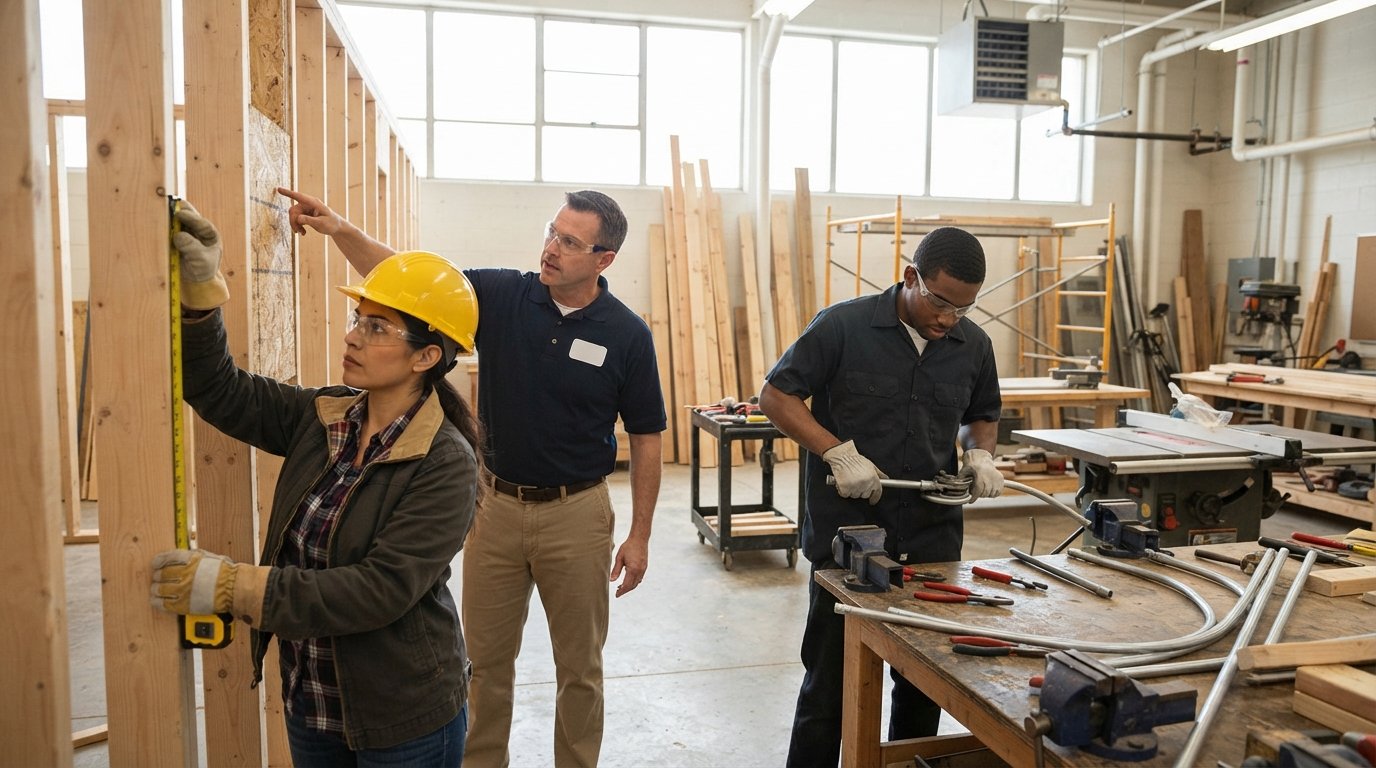
Atlantic Cape Community College structures the degree to be completed in about two years of full-time study. Because it is delivered in person, students spend significant time in labs and on simulated job sites. That hands-on component matters. You cannot learn to run conduit or frame a wall by reading a textbook alone. The in-person format also builds the kind of teamwork and communication skills that construction crews depend on every day.
Coursework typically includes construction math, blueprint reading, materials science, and an introduction to building codes. General education requirements in writing, communication, and math round out the degree. Some students worry that general education courses are a waste of time in a trade program, but they are not. Being able to read a spec sheet, write a clear email to a supplier, or calculate load requirements accurately can separate a good worker from a great one.
Why Choose an In-Person Program at Atlantic Cape
Online education has opened doors for many learners, but the construction trades are one field where in-person training is essential. You need to feel the weight of a tool, hear the sound of a saw, and practice safety procedures under supervision. Atlantic Cape Community College provides that environment. The college has invested in shop facilities and equipment that mirror what you will encounter on a real job site.
Location also matters. Atlantic Cape serves the southern New Jersey region, including Atlantic and Cape May counties. Students who train locally often build relationships with local contractors and unions. Those relationships frequently turn into job offers before graduation. An in-person program makes it easier to attend job fairs, meet guest speakers from the industry, and participate in internship or apprenticeship opportunities that are coordinated through the college.
Another advantage is the structure. In-person classes keep you on a schedule. For students who struggle with procrastination or who need the accountability of showing up somewhere, the physical campus can be a real benefit. You also get immediate access to instructors who have worked in the field. Asking a question in a classroom or shop is often faster and clearer than sending an email and waiting for a reply.
If you are considering whether to start at a community college and later transfer, it helps to understand how credits move between institutions. Our guide on how to transfer community college credits explains the process step by step, which can be useful if you ever decide to pursue a bachelor's degree in construction management or a related field.
Admission Requirements and How to Apply
Atlantic Cape Community College maintains open admission policies for most programs, and the Construction Trades, General Associate's degree is no exception. You will need a high school diploma or equivalent, such as a GED. Some students enter after completing a vocational certificate in a specific trade. The college may require placement testing in math and English to make sure you start in the right courses.
The application process is straightforward. Here are the typical steps:
- Submit an online application through the Atlantic Cape website.
- Provide proof of high school completion or equivalent.
- Complete placement testing or submit SAT, ACT, or prior college transcripts if available.
- Meet with an academic advisor to plan your course sequence.
- Register for classes and pay tuition or set up a payment plan.
Advisors play a critical role here. Because the program includes both trade courses and general education, mapping out a two-year plan prevents wasted credits and keeps you on track. Ask about evening or part-time options if you need to work while studying. Many students in trade programs hold jobs during the day and attend classes at night or on weekends.
Financial aid is available for eligible students. This includes federal grants, state aid, and scholarships specifically for trade and technical programs. The college financial aid office can help you fill out the FAFSA and explore options. Some employers also offer tuition reimbursement for employees who want to upgrade their skills, so it is worth asking your current employer if that benefit exists.
Career Outcomes and Salary Expectations
Graduates of this program enter a job market that consistently needs skilled workers. Construction is not an industry that can be outsourced overseas. Buildings need to be built, repaired, and renovated locally. That reality creates steady demand for people with formal training in the trades.
Common job titles for graduates include construction technician, carpenter assistant, electrician helper, plumbing apprentice, and HVAC installer. Some graduates move into estimating, project coordination, or site supervision after gaining experience. The general nature of the degree means you are not locked into one path. You can try different areas and find the one that fits your strengths.
Salary varies by trade, location, and experience level. Entry-level positions in southern New Jersey might start in the range of 35,000 to 45,000 dollars per year. With a few years of experience and a specialization, earnings can climb well above 60,000 dollars. Licensed electricians and plumbers often earn more, especially if they run their own businesses. Union positions typically offer strong benefits and pension plans.
It is also worth noting that construction management roles often pay more than field positions and may require additional education. A bachelor's degree in construction management can lead to salaries above 80,000 dollars in many markets. The associate's degree from Atlantic Cape can serve as a stepping stone toward that goal if you decide to continue your education later.
Comparing This Program to Other Options
Prospective students often weigh an associate's degree against a short-term vocational certificate. A certificate in welding or HVAC can be completed in less than a year and gets you into the workforce faster. The associate's degree takes longer but provides broader knowledge and better long-term mobility. If your goal is to become a supervisor, estimator, or business owner, the degree is usually the better investment.
Another option is a registered apprenticeship. Apprenticeships combine paid on-the-job training with classroom instruction and are highly respected in the trades. Some students do both: they enroll in the associate's program while working as an apprentice. This can be challenging but offers the best of both worlds, income while you learn and a credential that opens doors later.
You can also explore sponsored online and campus degree programs through matching services. These platforms let you compare school listings by subject or state and request information without obligation. One example is TopStudents, a college matching site that helps prospective students connect with programs that fit their goals. Using a matching service can save time and surface options you might not have found on your own.
Tips for Success in the Program
Students who do well in the Construction Trades, General Associate's degree tend to share a few habits. First, they show up. Attendance in a hands-on program is not optional. Missing a lab session means missing a skill you will need later. Second, they ask questions. Instructors in trade programs generally have industry experience and are happy to share it. Third, they treat safety as a priority from day one. Learning to work safely is not just about avoiding injury. It is about developing the professional habits that employers expect.
Networking matters too. Get to know your classmates, because they will be your colleagues in the field. Join any student organizations related to construction or engineering. Attend career fairs and industry events. Many jobs in the trades are filled through word of mouth, so the more people who know you and your work ethic, the better.
Finally, keep your options open. The construction industry is changing. Green building, energy efficiency, and smart building technology are growing areas. A general associate's degree gives you a foundation that can adapt as the industry evolves. You might start in framing and later move into solar installation or building automation. The key is to keep learning.
Earning a Construction Trades, General Associate's degree, usually 2 years In-person at Atlantic Cape Community College, is a practical step toward a stable and rewarding career. The program combines hands-on training with the academic background that helps you advance over time. If you are ready to build something real, this could be the path for you.