
Dental Assisting Associate Degree at College of Central Florida
Explore the Dental Assisting/Assistant Associate's degree, usually 2 years In-person at College of Central Florida. Call 8772187081 for guidance today.

By Stacy Harper
Stepping into a dental office as a trained assistant means you are the person who keeps treatment moving, keeps patients calm, and keeps the dentist focused on clinical care. The Dental Assisting/Assistant Associate's degree, usually 2 years In-person at College of Central Florida, gives you a structured path into that role, combining laboratory practice, chairside training, and general education coursework on a campus in Ocala. For students who want a hands-on credential rather than a fully online program, this degree offers a clear timeline, a defined skill set, and a recognized credential that employers in Central Florida understand.
This article explains what the program covers, how the two-year schedule works, what it costs, how to apply, and what careers open up after graduation. It also covers how to compare this in-person option with other pathways, including flexible alternatives you can explore through a college matching service such as TopStudents if you are still weighing your options.
What the Dental Assisting Associate Degree Covers
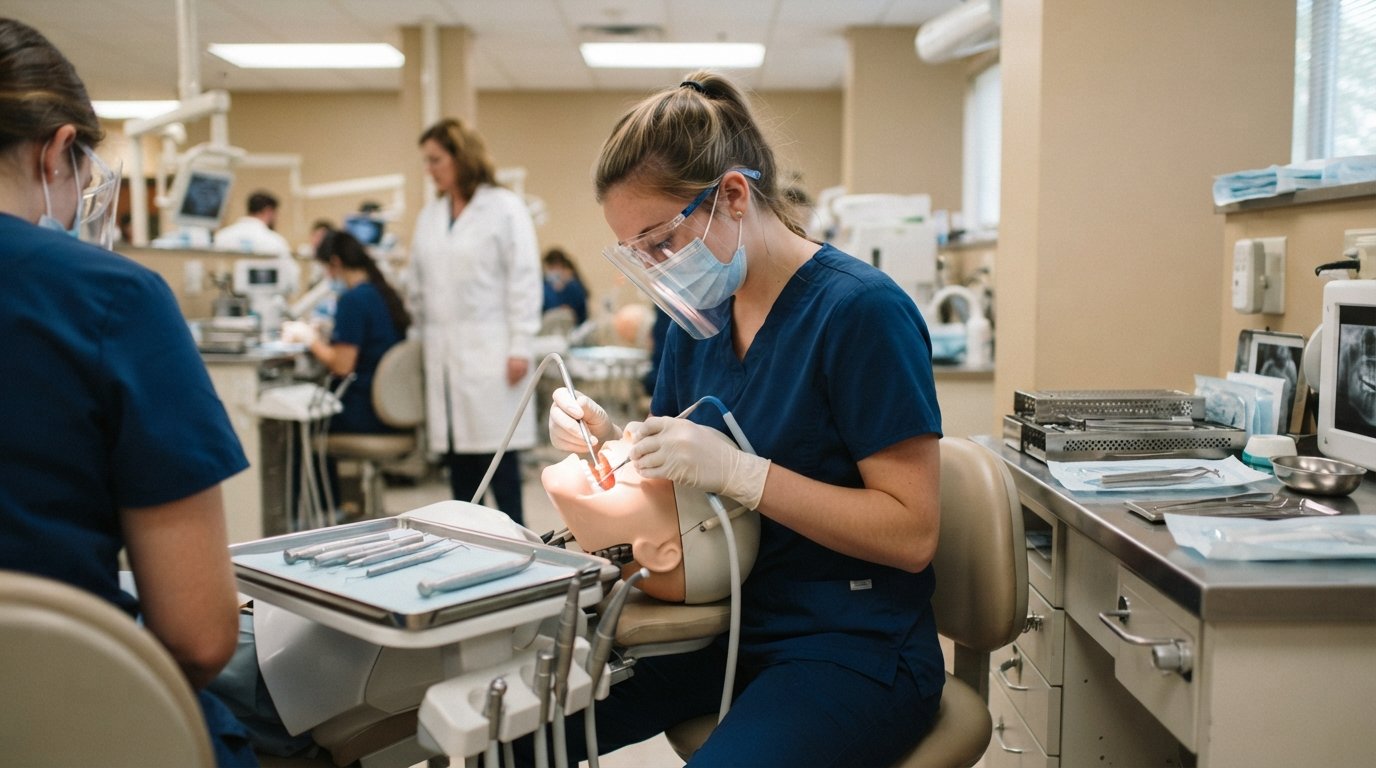
The program at College of Central Florida is built around the daily realities of a dental practice. You learn how to prepare operatories, sterilize instruments, take and process radiographs, mix dental materials, assist with four-handed dentistry, and manage patient records. Classroom instruction is paired with supervised clinical experience, so you graduate having already practiced the tasks you will perform on the job.
General education courses round out the degree. You take classes in communication, mathematics, and social sciences alongside your dental courses, which is one reason the credential is an Associate of Science rather than a short certificate. That broader foundation can help if you later pursue a bachelor's degree in dental hygiene, healthcare administration, or a related field.
Key subject areas typically include:
- Dental anatomy, tooth morphology, and oral pathology basics
- Infection control, sterilization, and safety protocols
- Radiography and dental imaging techniques
- Chairside assisting and four-handed dentistry
- Dental materials, impressions, and laboratory procedures
- Patient communication and practice management
Because the program is delivered in person, you get access to simulation labs, radiographic equipment, and instructors who can correct your technique in real time. That hands-on feedback is difficult to replicate in a fully online format, and it is a major reason many employers prefer graduates of campus-based programs.
Why the Two-Year In-Person Format Matters
A two-year associate degree is long enough to build real competence but short enough to keep you moving toward employment quickly. The in-person requirement is not just a formality. Dental assisting is a physical, tactile profession. You need to develop muscle memory for instrument passing, learn to position yourself ergonomically, and practice responding to a dentist's cues without hesitation. Those skills are built through repetition in a supervised lab, not through watching videos.
The campus setting also creates structure. You attend classes and labs on a set schedule, which helps you build study habits and professional routines. Many students find that the cohort model, where you progress through the program with the same group of peers, provides accountability and a built-in support network. If you are comparing this with other credentials, our guide to an Administrative Assistant Associate's Degree at CLTCC shows how another two-year program structures its coursework and career outcomes, which can help you weigh different paths.
That said, the in-person format does require flexibility. You will need to commute to campus, attend daytime labs, and complete clinical hours that may not fit around a full-time job. Prospective students should plan their work schedules and family commitments accordingly before enrolling.
Admission Steps and Practical Requirements
Admission to the dental assisting program typically involves more than submitting a general college application. You usually need to apply to the college, meet placement requirements in math and English, complete prerequisite coursework, and submit a separate application to the health sciences program. Some cohorts also require a background check, health screening, immunizations, and CPR certification before clinical rotations begin.
The process generally follows a sequence like this:
- Apply to College of Central Florida and establish residency status.
- Submit transcripts and take placement tests if needed.
- Complete prerequisite courses such as biology, English, and math.
- Apply to the dental assisting program during the designated window.
- Complete health, safety, and background requirements before clinical placement.
Because health sciences programs often have limited seats, meeting the minimum requirements does not guarantee admission. Competitive applicants tend to have strong grades in prerequisite courses and a clear understanding of the profession. Attending an information session or speaking with an advisor can help you avoid missed deadlines.
Cost, Financial Aid, and Return on Investment
Tuition for an in-state student at a Florida public college is generally lower than at private institutions, but you should still budget for lab fees, uniforms, instruments, textbooks, and certification exam costs. Financial aid options include federal grants, student loans, work-study, and Florida Bright Futures for eligible students. Some employers also offer tuition reimbursement, especially if you already work in a dental office.
To estimate your return on investment, compare total program cost against the median salary for dental assistants in your area. In Florida, dental assistants typically earn an hourly wage that, at full-time hours, produces a stable annual income. The two-year degree can position you for higher pay than an entry-level on-the-job trainee, and it may open doors to expanded functions or supervisory roles over time.
It is also worth noting that the credential is stackable. After completing the associate degree, you can pursue additional certifications in expanded functions, dental radiology, or practice management. Some graduates continue on to a bachelor's degree in a healthcare field, using their dental assisting credits as a foundation.
Career Outcomes and Certification
Graduates typically find work in general dental practices, orthodontic offices, oral surgery clinics, pediatric dentistry, and public health settings. The day-to-day role involves preparing patients, assisting during procedures, managing infection control, taking radiographs, and handling administrative tasks such as scheduling and billing. Because dental offices operate on tight schedules, assistants who are organized and calm under pressure are especially valued.
Certification requirements vary by state. In Florida, dental assistants can earn credentials such as the Certified Dental Assistant (CDA) or Registered Dental Assistant (RDA) status, depending on the expanded functions they perform. Many employers prefer or require certification, and the associate degree program is designed to prepare you for those exams.
Career growth can take several forms. Experienced assistants may move into office management, become clinical coordinators, teach in dental assisting programs, or transition into sales roles with dental supply companies. Each of these paths benefits from the clinical knowledge and patient communication skills you build during the two-year program.
Comparing In-Person and Online Pathways
Fully online dental assisting programs are rare because the profession requires hands-on clinical training. However, some schools offer hybrid formats where lecture coursework is online and lab work is completed on campus or at a partner clinic. If you are exploring options beyond College of Central Florida, it helps to understand which parts of the training can be completed remotely and which cannot.
For students who need maximum flexibility, adjacent fields such as medical billing, health administration, or administrative assisting may offer more online options. These roles do not require chairside clinical skills, and they can be completed through distance learning. A college matching service can help you compare sponsored online and campus programs by subject or state, request information from schools, and review program details without any obligation to apply.
When comparing programs, focus on these factors:
- Accreditation status and program length
- Clinical hour requirements and site placement support
- Certification exam pass rates and job placement rates
- Total cost, including fees, instruments, and uniforms
- Schedule flexibility and commute distance
These criteria help you separate programs that fit your life from those that only look good on paper. A two-year in-person degree is a significant commitment, so it is worth taking time to confirm that the format, cost, and career goals align.
Is This Program Right for You?
The Dental Assisting/Assistant Associate's degree, usually 2 years In-person at College of Central Florida, suits students who want direct patient contact, prefer learning by doing, and are ready to commit to a structured campus schedule. It is a strong choice if you live near Ocala, plan to work in Central Florida, and want a credential that employers in the region recognize. It is less suitable if you need a fully online program or cannot attend daytime labs.
Before enrolling, visit the campus, speak with current students, and review the program's accreditation and outcomes data. Ask about clinical placement sites, exam pass rates, and support services. The more you know upfront, the fewer surprises you will face during the program.
If you are still exploring, take advantage of free matching tools to compare dental assisting programs with other healthcare and administrative pathways. The goal is not just to earn a degree, but to earn the right degree for the career you actually want. With careful research and a clear plan, the two-year dental assisting program can be a practical, rewarding step toward a stable healthcare career.