
IT Certificate at College of the Sequoias: 1-Year In-Person
Explore the Information Technology Certificate, 1 year to less than 2 years In-person at College of the Sequoias. Call (877)-218-7081 to compare programs today.

By Valerie Miller
Finding a fast, affordable path into the technology field can feel overwhelming when four-year degrees dominate the conversation. For students in California's Central Valley, the Information Technology Certificate, 1 year to less than 2 years In-person at College of the Sequoias offers a practical alternative: a hands-on credential that can be completed in roughly 12 to 24 months without relocating or committing to a bachelor's program. This certificate is designed for people who want job-ready skills in networking, hardware, software support, and cybersecurity fundamentals, and who prefer learning in a classroom and lab environment rather than fully online.
College of the Sequoias (COS) is a community college based in Visalia, California, with additional locations in Hanford and Tulare. Its career and technical education programs are built around regional workforce needs, and information technology sits near the top of that list. Employers across Tulare and Kings Counties regularly hire entry-level IT support staff, help desk technicians, and network assistants, and a certificate signals that a candidate has completed structured, supervised training.
What the Information Technology Certificate Covers
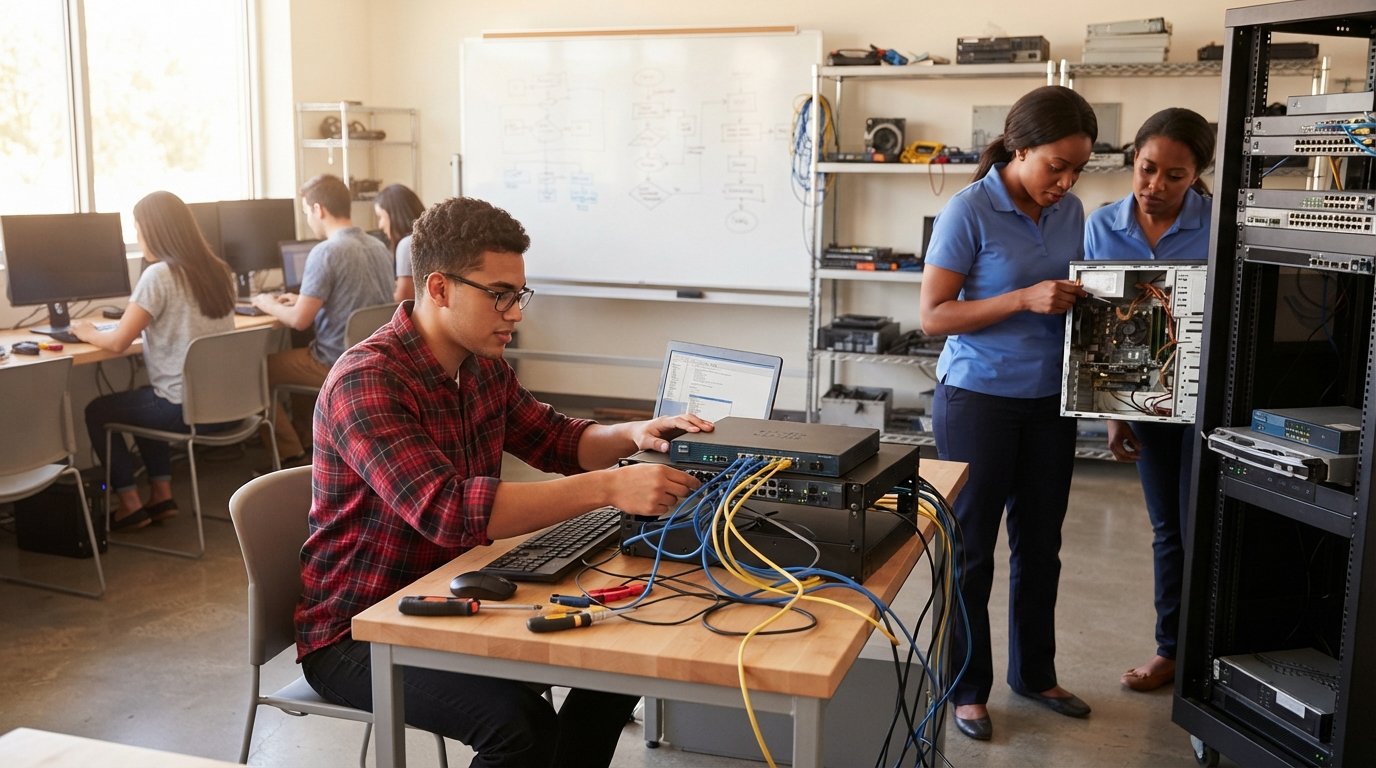
The certificate pathway at College of the Sequoias blends general computer literacy with specialized technical coursework. Students typically begin with foundational classes in operating systems, computer hardware, and productivity software before advancing into networking, server administration, and security topics. Because the program is delivered in person, much of the learning happens through direct lab work: assembling and troubleshooting machines, configuring routers and switches, and practicing command-line tools on real equipment.
Course content generally maps to industry expectations for entry-level roles. You can expect to study areas such as:
- Computer hardware and operating system fundamentals, including Windows and Linux environments
- Networking concepts, IP addressing, routing, and switching
- Cybersecurity basics, including threat awareness and access control
- Help desk and customer support practices
- Introductory programming or scripting for automation tasks
Many students pair the certificate with preparation for industry certifications such as CompTIA A+, Network+, or Security+. While the college certificate and vendor certifications are separate credentials, the coursework overlaps significantly, which means the same study hours can support both goals. That combination is one reason employers in the region recognize the program: it produces candidates who can demonstrate both academic completion and, often, third-party validation of their skills.
Why the In-Person Format Matters for IT Training
Information technology is a field where hands-on repetition matters. Reading about subnetting or RAID configurations is useful, but physically working with hardware and network devices builds muscle memory that online-only programs sometimes struggle to replicate. The in-person format at College of the Sequoias gives students access to campus computer labs, networking equipment, and instructors who can look over their shoulder and correct mistakes in real time.
There is also a scheduling benefit. Students who attend on campus often find it easier to form study groups, attend office hours, and use tutoring services. For adult learners returning to school after years away, that structure can be the difference between finishing a certificate and abandoning it halfway through. The 1 year to less than 2 years timeline is short enough to maintain momentum but long enough to absorb complex material without cramming.
That said, in-person study requires geographic proximity to Visalia, Hanford, or Tulare, or a willingness to commute. Prospective students who need maximum flexibility should compare this option against fully online alternatives. Resources that help learners compare formats, costs, and program lengths can make that decision easier, and platforms like TopStudents college matching tools allow students to explore both online and campus degree programs side by side before committing.
Admission Steps and Program Logistics
Enrolling in the Information Technology Certificate, 1 year to less than 2 years In-person at College of the Sequoias follows the standard community college admissions process. There is no competitive entrance exam for the certificate itself, which makes it accessible to recent high school graduates, career changers, and returning adults alike. The main steps look like this:
- Apply to College of the Sequoias through the California Community Colleges application system.
- Complete assessment or placement steps for math and English, if required.
- Meet with an academic counselor to map certificate courses across your target timeline.
- Register for classes each term and maintain satisfactory academic progress.
- File the Free Application for Federal Student Aid (FAFSA) to determine eligibility for grants and fee waivers.
California community college fees are among the lowest in the nation, and the California College Promise Grant can waive enrollment fees entirely for qualifying students. That means the total cost of the certificate may be limited to books, supplies, and transportation. Students should confirm current fee schedules and financial aid options directly with the college, since amounts and eligibility rules change from year to year.
Course availability also matters. Not every required class is offered every semester, so students who want to finish in the shorter end of the 1 year to less than 2 years window should work closely with a counselor to sequence courses strategically. Evening and part-time schedules may extend the timeline, while full-time enrollment can compress it.
Career Outcomes and Salary Expectations
Graduates of IT certificate programs typically enter the workforce in support-oriented roles. Common job titles include help desk technician, desktop support specialist, IT assistant, and network support technician. In the Visalia and Tulare area, these roles often start in the range of $18 to $25 per hour, with pay increasing as technicians earn certifications and accumulate experience. Statewide, California IT support wages run higher, especially in the Bay Area and Los Angeles, though competition for those positions is also stronger.
The certificate also serves as a stepping stone. Many students work in entry-level roles while continuing toward an associate degree or transferring to a four-year institution. Credits earned in the certificate often apply toward COS associate degrees in computer science or related fields, which means the credential does not have to be a terminal one. For students weighing certificate versus degree pathways, exploring broader program directories can reveal how different credentials stack. Our guide to a one-year drafting and design certificate shows a similar short-credential structure in a different technical field, which can help you compare how quickly various certificates translate into employment.
It is worth noting that IT hiring managers frequently prioritize demonstrated skills and certifications over the specific credential name. A certificate from College of the Sequoias carries weight locally because employers know the program, but candidates should still build a portfolio, pursue CompTIA or Cisco certifications, and gain any hands-on experience they can through internships or campus IT work-study positions.
Is This Certificate the Right Fit for You?
The Information Technology Certificate, 1 year to less than 2 years In-person at College of the Sequoias fits students who want structured, affordable, face-to-face training close to home. It is a strong choice for people in the Central Valley who plan to work locally, who learn best with instructor guidance and lab access, and who want to enter the job market quickly without taking on significant student debt.
It may be a weaker fit for students who need fully online flexibility, who already hold advanced IT credentials, or who intend to pursue research-oriented computer science careers that require a bachelor's degree or higher. Those learners should compare other options, including online certificate programs and university degree paths, before enrolling.
Prospective students can also use free matching services to request information from multiple schools at once and compare responses. There is no obligation to apply or enroll, and gathering details from several programs side by side often clarifies which format, cost, and schedule genuinely match your goals. Before registering, visit the campus, talk to current students, and ask instructors about job placement rates and certification pass rates for recent cohorts.
For anyone in the Visalia, Hanford, or Tulare area who wants a practical, affordable route into technology work, this certificate deserves a serious look. It combines the speed of a short credential with the depth of in-person instruction, and it positions graduates for entry-level roles that can grow into specialized, higher-paying careers over time.