
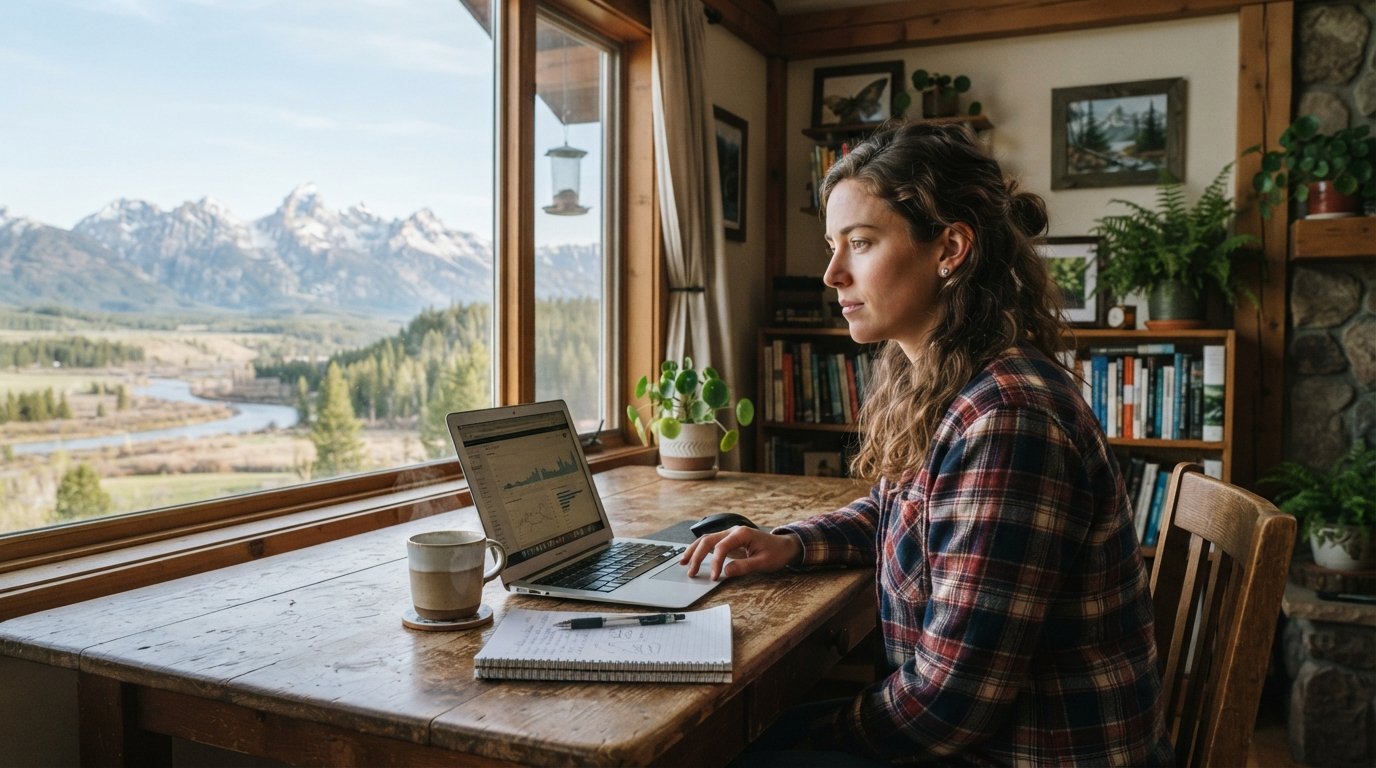
Online Degree Programs in Idaho for Rural Students
Online degree programs in Idaho for rural students offer flexibility and local career growth. Call 8772187081 for guidance on finding the right fit.

By Valerie Miller
Living in a rural Idaho community should not limit your access to a college education. Whether you live near the Sawtooth Mountains, in the farm country of the Magic Valley, or in a small town along the Salmon River, the distance to a major university campus can feel like an impossible barrier. Online degree programs in Idaho for rural students close that gap. They let you earn a regionally accredited degree from your kitchen table, your local library, or a community center, without relocating or driving hours each week.
Idaho is one of the most geographically dispersed states in the country. Nearly 30 percent of its residents live in rural areas, and many of those communities sit more than 60 miles from the nearest four-year college. That reality has shaped how the state approaches higher education. Public universities, private colleges, and community colleges now offer dozens of fully online programs designed specifically for students who cannot uproot their lives to attend classes on campus.
This guide explains how online degree programs in Idaho for rural students work, which schools offer them, what they cost, and how to choose a program that fits your career goals. It also covers the practical challenges rural learners face, from spotty internet access to limited advising, and shows you how to work around them.
Why Online Learning Fits Rural Idaho So Well
Rural students in Idaho face a unique set of obstacles that traditional campus programs were never designed to solve. The state covers more than 83,000 square miles, and its population is concentrated in a handful of metro areas: Boise, Coeur d'Alene, Idaho Falls, Pocatello, and Twin Falls. Outside those hubs, access to higher education shrinks fast.
Consider what a typical rural student encounters. A student in Challis who wants a bachelor's degree in business would need to drive roughly three hours to Boise or two and a half hours to Pocatello. That commute is not sustainable alongside a job, family responsibilities, or both. Moving to a college town is often financially impossible, especially for students who own homes, work on family farms, or care for aging parents.
Online programs remove those barriers. They deliver lectures, assignments, discussions, and exams through a learning management system that runs on a laptop or even a smartphone. You can study at 5 a.m. before your shift starts or at 10 p.m. after your kids are asleep. For many rural Idahoans, this flexibility is the difference between earning a degree and never finishing one.
There is also an economic argument. Rural Idaho communities need nurses, teachers, accountants, IT specialists, and business managers. When local residents earn degrees online, they tend to stay in their communities rather than leaving for urban job markets. That keeps talent, tax revenue, and civic leadership in places that need it most.
Public Universities in Idaho With Strong Online Options
Idaho's public university system has embraced online education in a significant way. Three institutions stand out for rural students: Boise State University, the University of Idaho, and Idaho State University. Each offers fully online degrees that carry the same accreditation as their on-campus equivalents.
Boise State University runs Boise State Online, which includes more than 70 fully online programs at the bachelor's, master's, and certificate levels. Popular options include the online Bachelor of Business Administration, the RN to BSN nursing completion program, and master's degrees in educational technology and public administration. Boise State uses the same faculty who teach on campus, and online students pay a flat per-credit rate that does not include out-of-state surcharges. That matters for rural students who live in Idaho but might technically fall outside a service area.
The University of Idaho offers U of I Online, with degree programs in fields like psychology, criminology, environmental science, and organizational sciences. The university also provides a strong set of student support services for online learners, including virtual tutoring, online advising, and a dedicated help desk. For rural students who need structure, these services can be the difference between staying enrolled and dropping out.
Idaho State University in Pocatello has one of the oldest distance education programs in the state. Its online offerings include degrees in health sciences, nursing, business, and education. ISU also operates regional centers in Twin Falls, Idaho Falls, and Meridian, which can serve as testing sites or advising hubs for students who live nearby but still cannot attend full-time on campus.
These three universities form the backbone of online degree programs in Idaho for rural students. Because they are public institutions, they also tend to be more affordable than private online colleges, especially for Idaho residents who qualify for in-state tuition rates.
Community Colleges and Technical Programs Online
Not every rural student needs a four-year degree. Many high-demand jobs in Idaho require an associate degree or a technical certificate, and community colleges have moved aggressively into online delivery. The College of Southern Idaho, North Idaho College, and the College of Western Idaho all offer online courses and programs that can be completed from anywhere in the state.
The College of Southern Idaho in Twin Falls offers online associate degrees in business, general studies, and criminal justice, plus certificates in areas like medical billing and coding. North Idaho College in Coeur d'Alene provides online options in accounting, early childhood education, and web design. The College of Western Idaho, based in Nampa, has expanded its online catalog to include technical certificates in fields such as cybersecurity and surgical technology (with some in-person clinical components).
These programs are especially valuable for rural students who want to enter the workforce quickly or who plan to transfer to a four-year university later. Many community college credits transfer seamlessly to Boise State, the University of Idaho, or Idaho State, which means a student can start online at a lower cost and finish a bachelor's degree without ever leaving home.
For students exploring other states or comparing regional options, our guide on online degree programs in New Mexico for adult learners shows how similar rural challenges are addressed elsewhere, which can help you benchmark Idaho's offerings.
Private and Nonprofit Online Options Worth Considering
Idaho also hosts private institutions that serve rural learners. Brigham Young University-Idaho in Rexburg runs a large online program through BYU-Idaho Online, with degrees in fields like applied management, family history research, and web design. Northwest Nazarene University in Nampa offers online bachelor's and master's programs in business, nursing, and education. These schools often have smaller class sizes and a more personalized approach, though tuition can be higher than public options.
National nonprofit online universities also enroll Idaho students. Western Governors University, for example, is competency-based and allows students to move through material as quickly as they can demonstrate mastery. That model can save time and money for self-motivated learners. However, rural students should verify that any out-of-state institution is regionally accredited and authorized to operate in Idaho before enrolling.
The key is to compare total cost, accreditation, program format, and support services. A degree from a well-known public university in Idaho may carry more local weight with employers than a degree from an unfamiliar out-of-state school, even if the out-of-state option is cheaper.
How to Choose the Right Online Program
With so many options available, rural students need a clear framework for decision-making. The wrong program can waste time and money, while the right one can launch a career. Start by defining your goal, then evaluate programs against a consistent set of criteria.
Here is a practical checklist you can use:
- Accreditation: Confirm that the school is regionally accredited by an agency recognized by the U.S. Department of Education. This ensures credits transfer and employers recognize your degree.
- Program format: Check whether courses are asynchronous (self-paced) or synchronous (scheduled live sessions). Asynchronous formats work better for students with unpredictable work schedules.
- Total cost: Look beyond tuition per credit. Factor in fees, technology costs, and any required residencies or clinical placements.
- Support services: Ask about online tutoring, career counseling, library access, and technical support. Rural students often need these services more than campus students do.
- Transfer policy: If you have prior college credits or an associate degree, confirm how many credits the school will accept.
After you narrow your list, contact each school and ask specific questions. How do online exams work? What happens if your internet goes down during a test? Is there a local proctoring site? Are there any required campus visits? The answers will tell you whether a program truly understands rural students or simply treats them as an afterthought.
If you want help comparing sponsored programs by subject or state, a college matching service such as TopStudents can connect you with participating schools and let you request information without any obligation to apply or enroll.
Costs, Financial Aid, and Idaho-Specific Scholarships
Cost is often the biggest concern for rural students. The good news is that online degree programs in Idaho for rural students are generally more affordable than many people expect, especially when you avoid relocation and commuting expenses.
As a rough guide, online undergraduate tuition at Idaho's public universities ranges from about $250 to $400 per credit for in-state residents. A 120-credit bachelor's degree could therefore cost between $30,000 and $48,000 in tuition alone. Community college online courses are cheaper, often $100 to $200 per credit. Private universities and out-of-state online programs can run higher, sometimes $500 or more per credit.
Financial aid can reduce those numbers significantly. Idaho students can apply for federal Pell Grants, Idaho State Opportunity Grants, and the Idaho Promise Scholarship, which covers tuition and fees for eligible recent high school graduates at participating Idaho institutions. Adult learners should also check with their employer about tuition reimbursement programs, which are common in healthcare, manufacturing, and technology fields.
One more tip: ask each school whether online students pay in-state or out-of-state rates. Some public universities charge a single flat rate for online programs regardless of residency, which can be a major advantage for rural students who live near a state border.
Overcoming Rural Challenges: Internet, Technology, and Isolation
Rural Idaho has real infrastructure challenges. Broadband access is uneven, and some communities still rely on satellite internet or mobile hotspots. Before you enroll in any online program, test your connection speed and reliability. If your home internet is unreliable, identify backup options such as a local library, a community center, or a friend's house with fiber service.
Technology requirements matter too. Most online programs require a reliable computer, a webcam, and a stable internet connection for exams and video discussions. Some schools loan laptops or provide mobile hotspots to students who need them. Ask about these resources early.
Isolation is another challenge. Online learning can feel lonely, especially when you are the only student in your town taking a particular course. Combat this by joining virtual study groups, participating actively in discussion boards, and connecting with other online students through social media or local meetups. Many Idaho universities also assign online students a success coach who checks in regularly and helps with time management.
Finally, do not overlook the value of local mentors. A nurse at your county hospital, a teacher at the local school, or a small business owner in town can provide practical advice and encouragement. Rural communities are often tightly knit, and that social capital can be a powerful asset in your educational journey.
Career Outcomes and Local Job Markets
Earning a degree online does not mean settling for a lesser career. Employers in Idaho and across the country recognize degrees from accredited online programs, and many graduates find that their flexibility and self-discipline make them attractive candidates.
In rural Idaho, the strongest demand is in healthcare, education, business management, and skilled trades. Online RN to BSN programs help working nurses advance without leaving their hospitals. Online teaching degrees address chronic teacher shortages in small districts. Business and accounting degrees support local entrepreneurs and municipal governments. IT and cybersecurity certificates open doors to remote work, which allows rural residents to earn urban salaries while living where they choose.
Before you choose a program, research the job market in your region. Talk to employers, check state workforce data, and look at job postings for the roles you want. If possible, choose a program that includes an internship, practicum, or capstone project that connects you with local employers. Those experiences often lead directly to job offers.
Online degree programs in Idaho for rural students are not a compromise. They are a practical, flexible, and increasingly respected path to a better career. With careful research and the right support, you can earn a degree that changes your life without leaving the community you love.