
Welding Certificate at College of the Albemarle: 12 Weeks
The Welding Technology/Welder Certificate at College of the Albemarle delivers in-person training in 12 weeks to under a year, preparing you for entry-level welding jobs fast.

By Justin Thomas
Skilled welders are in demand across shipyards, construction sites, fabrication shops, and manufacturing plants, and one of the fastest ways to enter this trade is through a focused certificate program. The Welding Technology/Welder Certificate, 12 weeks to less than 1 year In-person at College of the Albemarle gives students a direct path from beginner to job-ready welder without committing to a multi-year degree. For anyone in northeastern North Carolina who wants hands-on training and a quick route to employment, this program deserves a close look.
Why Welding Training Pays Off So Quickly
Welding sits in an unusual spot in the labor market: the work is highly technical and safety-critical, yet employers often hire on demonstrated skill rather than a four-year diploma. That combination makes short-term certificates extremely valuable. A student can complete a welding certificate in a matter of months, walk into a fabrication shop or shipyard with a portfolio of practice welds, and pass a certification test that opens doors immediately.
The U.S. Bureau of Labor Statistics projects steady demand for welders, cutters, solderers, and brazers, with tens of thousands of openings each year as experienced workers retire and infrastructure and manufacturing activity continues. In coastal North Carolina, shipbuilding and repair, aerospace suppliers, and general construction all compete for trained welders, which keeps local wages competitive for people who can pass a weld test on day one.
What makes the certificate route attractive is the ratio of time to payoff. Instead of two or four years of tuition and lost wages, a 12-week to under-one-year program concentrates the essential skills (arc welding, MIG, TIG, blueprint reading, safety) into a short, intense block. Graduates typically enter the workforce faster, start earning sooner, and can add advanced certifications later while employed. For adult learners switching careers or high school graduates who want to avoid debt, that math is hard to beat.
Program Overview: Welding Technology/Welder Certificate at College of the Albemarle
College of the Albemarle (COA) is a community college serving northeastern North Carolina, with campuses in Elizabeth City, Edenton, and Manteo, plus regional sites. Its Welding Technology program is delivered in person, which matters enormously in this trade: welding is a psychomotor skill, and no online module can replace time under the hood with an instructor correcting your travel speed, angle, and arc length in real time.
The certificate pathway is designed to be stackable. Students can start with a short certificate that covers core welding processes, then continue into a diploma or associate degree if they want supervisory or specialized roles later. The 12-week to less-than-one-year timeframe reflects the fact that different certificate levels exist within the program, and the exact length depends on which credential a student pursues and whether they attend full time or part time.
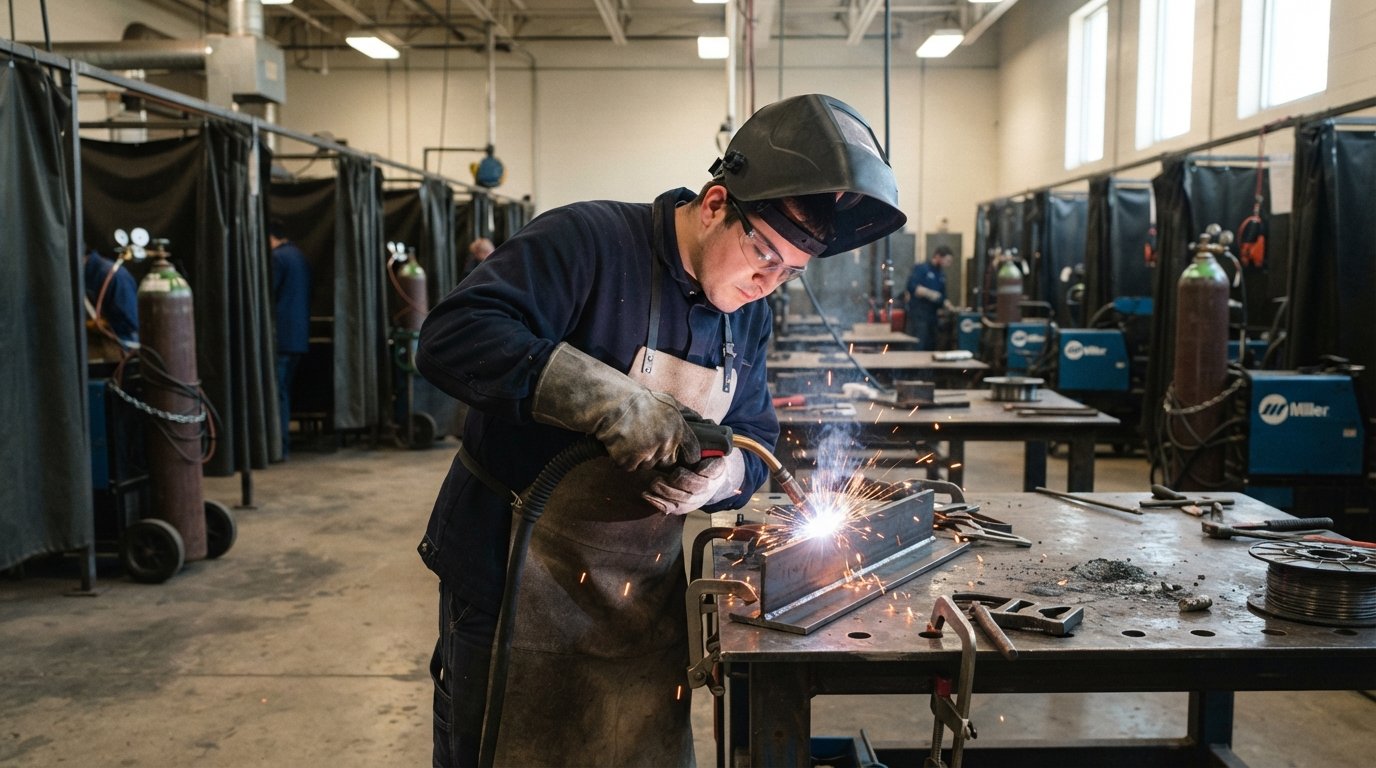
Because the training is in person, students get access to welding booths, oxyfuel cutting stations, shielded metal arc welding (SMAW) equipment, gas metal arc welding (GMAW/MIG) machines, gas tungsten arc welding (GTAW/TIG) setups, and plasma cutting tools. They also work with the same safety gear they will use on the job: helmets, gloves, respirators, leathers, and proper ventilation systems. That hands-on repetition is what turns a beginner into someone who can pass an employer's weld test.
What You Will Learn
The curriculum typically blends classroom instruction with extensive lab hours. Students move from basic safety and theory into actual welding practice, gradually building the muscle memory and judgment that skilled welders rely on. Core topics usually include:
- Welding safety, including personal protective equipment, ventilation, fire prevention, and hazard recognition
- Shielded metal arc welding (stick) in flat, horizontal, vertical, and overhead positions
- Gas metal arc welding (MIG) and flux-cored arc welding for production and fabrication work
- Gas tungsten arc welding (TIG) for precision work on stainless steel and aluminum
- Oxyfuel cutting, plasma cutting, and basic fabrication and blueprint reading
Beyond the torch and electrode, students learn to read welding symbols, interpret blueprints, measure and lay out projects, and inspect their own work for defects like porosity, undercut, and incomplete fusion. These skills matter because employers do not just want someone who can run a bead; they want someone who can build a part correctly the first time.
Assessment is usually performance-based. Instructors grade welds on appearance, penetration, and structural soundness, and students may complete practice tests that mirror industry certification exams. That focus on measurable output is why graduates can often move directly into entry-level welding jobs or apprenticeships.
Admissions, Cost, and How to Get Started
Community college welding programs are generally open-access. Applicants typically need a high school diploma or equivalent, or they may qualify for dual enrollment while still in high school. Placement testing in math and English may be required, though welding certificates often have minimal academic prerequisites compared to degree tracks. Because the program is in person, students should also be prepared for a schedule that includes daytime labs and possibly evening sections.
Cost is one of the strongest arguments for this route. North Carolina community college tuition is among the most affordable in the country, and welding certificate programs are short enough that total costs stay low. Federal financial aid, state grants, workforce development funds, and scholarships for trade programs can further reduce out-of-pocket expenses. Many students also qualify for tuition assistance through employer partnerships or local workforce boards.
To get started, prospective students can follow a simple sequence:
- Apply to College of the Albemarle and submit transcripts or equivalency documentation.
- Complete placement testing or provide SAT/ACT scores if available.
- Meet with an advisor to choose the certificate level that matches your timeline and career goal.
- Register for classes early, since welding labs fill quickly and have limited booth capacity.
- Purchase required safety gear and tools, or confirm what the program provides.
Advisors can also explain how certificate credits stack into the diploma or associate degree, which is useful for students who want to start working fast but keep the door open for advancement. If you are comparing multiple short-term trade options, it helps to review how other accelerated certificates are structured, such as this guide to a pharmacy certificate at CLTCC, to see how 12-week formats balance lab time and scheduling.
Career Outcomes and Earning Potential for Welders
Welding wages vary widely by industry, location, and certification level. Entry-level welders in fabrication shops may start modestly, but pay rises quickly with proven skill, and specialized welders in shipbuilding, pipeline, or aerospace can earn well above the median. Overtime is common in many shops, and traveling welders or those willing to work in remote locations often command premium pay.
Career paths from a welding certificate include structural welder, pipe welder, MIG/TIG welder, fabrication technician, welding inspector (with additional training), and welding supervisor. Some graduates eventually open their own mobile welding businesses, serving farms, contractors, and homeowners. Others use welding as a foundation for related roles in quality control, engineering technology, or maintenance.
Certification matters. Employers frequently require welders to pass tests aligned with American Welding Society (AWS) standards or specific company procedures. A strong certificate program prepares students for those tests by drilling the same positions, processes, and joint configurations they will encounter. That is why hands-on, in-person training at a school like COA tends to produce graduates who are ready for the weld test rather than just familiar with the theory.
For students who want to explore related trade and technical programs before committing, a college matching service such as TopStudents can help you compare campus and online options by subject or state and request information without any obligation to apply. That kind of low-pressure research is useful when you are weighing a 12-week welding certificate against a longer diploma or a different trade entirely.
Is the Welding Certificate Right for You?
The Welding Technology/Welder Certificate, 12 weeks to less than 1 year In-person at College of the Albemarle fits people who want to work with their hands, do not want years of classroom time before earning, and are comfortable in a physically demanding environment. Welding requires focus, steady hands, and tolerance for heat, sparks, and standing for long periods. It rewards people who show up consistently and practice deliberately.
It is also a strong fit for career changers. Adults who have worked in retail, food service, or office jobs often find welding appealing because the skills are tangible, the demand is real, and the path to a paycheck is short. High school students can sometimes dual-enroll and finish a certificate shortly after graduation, entering the workforce with no student debt and a marketable skill.
Before enrolling, it is worth visiting the campus, touring the welding lab, and talking to instructors about job placement and local employer demand. Ask about pass rates on certification tests, what processes are emphasized, and whether the program helps with internships or job referrals. Those conversations will tell you more than any brochure about whether the program matches your goals.
Welding is not for everyone, but for those who take to it, a certificate from a hands-on program can compress years of uncertainty into a few months of focused training. The combination of short duration, in-person instruction, and strong regional demand makes the welding certificate at College of the Albemarle a practical, low-risk entry point into a durable trade.