
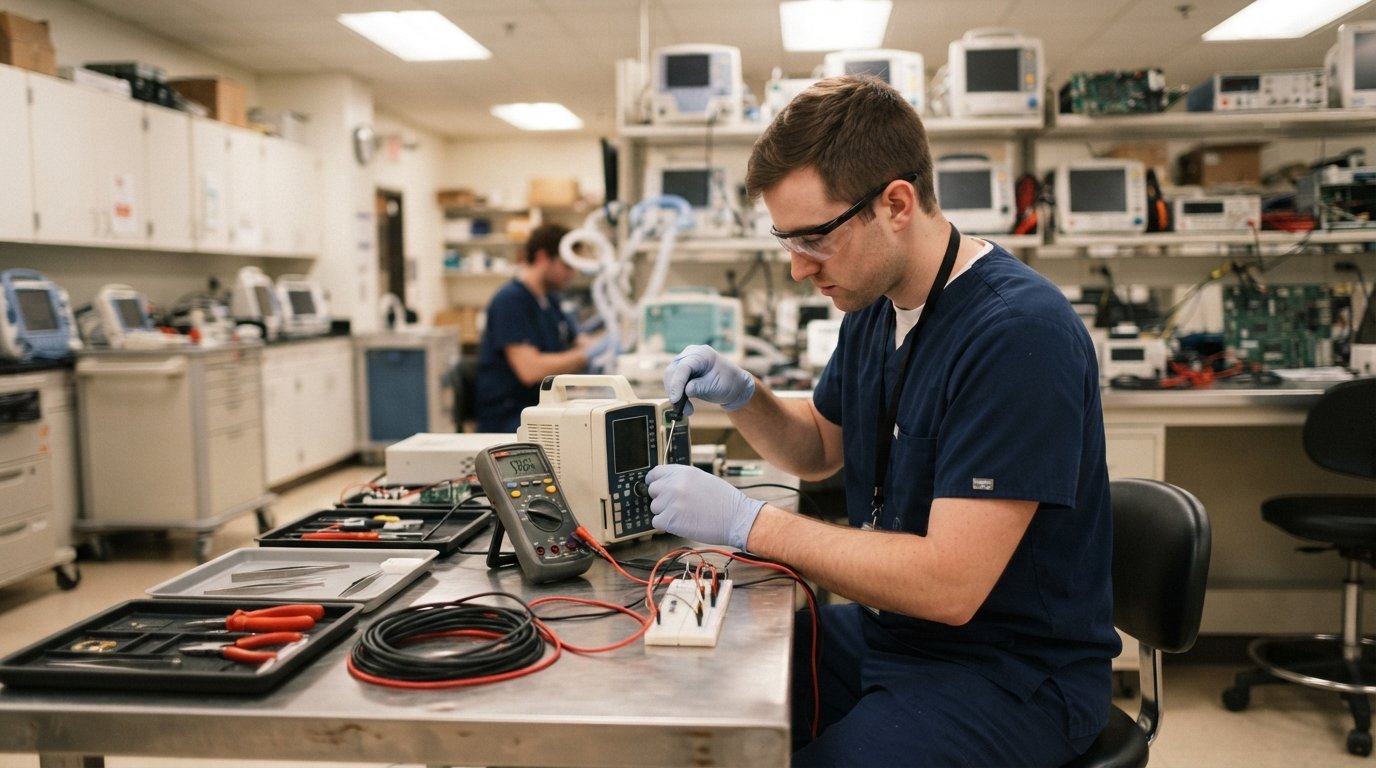
Biomedical Tech Certificate at Big Bend CC: 12 Weeks
Big Bend Community College offers a Biomedical Technology/Technician Certificate in 12 weeks to less than 1 year, in person, leading to hands-on BMET careers.

By Frank DeCicco
Imagine finishing a hands-on biomedical technology certificate in less than a year while training on the same equipment used in real hospitals. That is exactly what the Biomedical Technology/Technician Certificate, 12 weeks to less than 1 year In-person at Big Bend Community College offers to students who want a fast, practical route into healthcare technology. Instead of spending four years on a degree, you can gain job-ready skills in a compressed timeframe and step into a field where demand for trained technicians continues to grow. For career changers, recent high school graduates, and working adults in Washington State, this program represents a concrete path toward stable employment without the burden of a lengthy academic commitment.
Why Biomedical Equipment Technicians Are in Demand
Hospitals, clinics, and surgical centers depend on complex machines every single day: ventilators, infusion pumps, defibrillators, imaging systems, and laboratory analyzers. When those devices malfunction, patient safety and revenue are both at risk. Biomedical equipment technicians (BMETs) are the professionals who inspect, calibrate, repair, and maintain this equipment. Their work sits at the intersection of electronics, mechanics, and healthcare, and it cannot be outsourced to software alone because physical devices require physical hands.
The U.S. Bureau of Labor Statistics projects steady growth for medical equipment repairers, driven by an aging population, expanding healthcare facilities, and the constant introduction of new technology. Employers consistently report difficulty finding entry-level technicians who already understand both the clinical environment and the technical side of device maintenance. That gap is precisely what a focused certificate program is designed to fill. Students who complete short, intensive training can often move into roles faster than those pursuing broader engineering degrees, because employers value specific, verifiable hands-on competencies.
For anyone comparing healthcare career options, it helps to look at other fast-track credentials too. Programs such as a cardiovascular tech certificate in under 12 weeks show how quickly allied health training can translate into employment. Biomedical technology follows a similar logic: short, targeted instruction plus practical experience equals employability.
What the Biomedical Technology/Technician Certificate Covers
The program at Big Bend Community College is built around the core competencies that entry-level BMETs need on day one. Coursework typically blends classroom theory with extensive lab time, so students learn not just what a device does but how to diagnose it when it fails. Topics usually include electrical safety testing, schematic reading, soldering and wiring, preventive maintenance procedures, troubleshooting methodology, and an introduction to regulatory standards that govern medical devices.
Because the certificate can be completed in as little as 12 weeks or up to less than one year, the pacing is intensive but structured. Students who attend full time may finish within a single quarter or semester, while those balancing work or family obligations can spread the coursework across a slightly longer window. The in-person format at Big Bend Community College means learners get direct access to instructors, lab benches, and actual medical equipment rather than simulating repairs on a screen. That face-to-face interaction is especially valuable for building the manual dexterity and diagnostic intuition that employers expect.
Here is a closer look at the types of skills and knowledge areas the certificate typically emphasizes:
- Electrical and electronic fundamentals: measuring voltage, current, and resistance; interpreting circuit diagrams; safe handling of power supplies.
- Device-specific maintenance: servicing infusion pumps, patient monitors, defibrillators, and other common hospital equipment.
- Preventive maintenance and documentation: following manufacturer schedules, logging inspections, and maintaining compliance records.
- Troubleshooting and repair: systematic fault isolation, component replacement, and post-repair verification.
- Healthcare environment orientation: infection control, patient privacy basics, and working alongside clinical staff.
After completing these modules, graduates should be able to walk into a hospital biomedical department and perform supervised repairs, safety checks, and scheduled maintenance with confidence. The certificate does not replace an associate degree for advanced roles, but it does provide a credible entry point and a foundation that can be built upon later.
Admissions, Cost, and How to Enroll at Big Bend Community College
Big Bend Community College serves students in Moses Lake and the surrounding Columbia Basin region of Washington State. Admission to a certificate program is generally less competitive than admission to a full degree track, but applicants still need to meet basic requirements. These usually include a high school diploma or equivalent, placement in college-level math and English (or completion of developmental coursework), and the ability to commit to the in-person schedule. Some programs may also require a background check or immunizations because students will be training on or near healthcare equipment.
Cost is a major consideration for anyone weighing a short certificate against a longer degree. At a public community college like Big Bend, tuition for a certificate is typically a fraction of what a private technical school or four-year university would charge. Students should also explore financial aid options: federal grants, state workforce development funds, and scholarships for allied health students can reduce out-of-pocket expenses significantly. The college financial aid office can help applicants understand what they qualify for before they enroll.
To apply, prospective students should follow a sequence similar to this:
- Complete the college admission application online or through the admissions office.
- Submit official transcripts and any required placement test scores.
- Meet with an academic advisor to confirm the certificate fits your career goals and schedule.
- Apply for financial aid and any relevant workforce training grants.
- Register for classes and attend the program orientation before the term begins.
Because the program is in person and cohort-based, seats may be limited. Applying early gives you the best chance of securing a spot and arranging financial aid before the first day of class. For students who want to compare this path with other options, using a service like TopStudents can help you explore online and campus programs by subject or state and request information without any obligation to apply.
Career Outcomes and Salary Expectations for BMET Graduates
Graduates of a biomedical technology certificate typically pursue roles with titles such as biomedical equipment technician, medical equipment repairer, clinical engineering technologist (entry level), or field service representative for device manufacturers. Work settings include hospitals, outpatient surgery centers, dialysis clinics, imaging centers, and companies that lease or service medical equipment. Some technicians travel between facilities as field service reps, while others work primarily in a single hospital's biomedical department.
Pay varies by region, experience, and employer type. According to available labor data, entry-level BMETs in Washington State often start in a range that is competitive with other skilled trades, and earnings rise as technicians gain certifications and specialize in high-value equipment like imaging systems or life-support devices. Overtime opportunities are common in hospital settings because equipment must be maintained around the clock. With a few years of experience and additional manufacturer certifications, technicians can move into senior roles, supervisory positions, or sales and training roles for device companies.
It is also worth noting that the certificate can serve as a stepping stone. Many technicians eventually return to school part time to earn an associate or bachelor's degree in biomedical engineering technology, which opens doors to higher pay and more advanced responsibilities. Starting with a 12-week to less than one year certificate lets you enter the workforce and earn while you continue learning, rather than delaying employment for years.
Is This Fast-Track Certificate Right for You?
The Biomedical Technology/Technician Certificate, 12 weeks to less than 1 year In-person at Big Bend Community College is a strong fit for people who learn by doing, want to enter healthcare without direct patient care, and prefer a short, affordable training path over a traditional degree. It is also a good match for military veterans with electronics experience, IT professionals looking to move into healthcare technology, and anyone who enjoys troubleshooting and repair work.
Before enrolling, ask yourself a few practical questions. Can you commit to an in-person schedule for the duration of the program? Are you comfortable working with electrical systems and following strict safety protocols? Do you want to work in a hospital or clinic environment, even if you are not treating patients directly? If the answers are yes, this certificate can lead to a stable, respected career with clear advancement potential. Because the field is hands-on and equipment-dependent, the in-person format at Big Bend gives you an advantage that purely online programs cannot match: real tools, real devices, and real practice before you ever apply for a job.
Taking the next step means contacting Big Bend Community College admissions, speaking with an advisor about start dates, and confirming your financial aid options. With a focused 12-week to less than one year commitment, you could be job-ready in biomedical technology faster than you might expect.